Schemas
The join ran. Why did the total triple?
A diagram is useful when it tells you how many rows a join can produce. Follow one order through the tables.
Published 4 min read
Try the join example
Photo: Map of North and Central America, Nicolas Sanson, Adriaan de Winter and François Halma, Public domain, via Wikimedia Commons.
Imagine a shop with one order worth $30 and three order lines. Join the order to its lines and sum the order total. The query runs. The answer is $90.
No row is corrupt. The join repeated the parent total once for each matching line. A database schema diagram helps you spot that relationship before it reaches a report.
A small example with a wrong total
WITH orders(id, total_cents) AS (VALUES (1, 3000)),
order_items(order_id, line_no) AS (VALUES (1, 1), (1, 2), (1, 3))
SELECT SUM(o.total_cents) AS wrong_total_cents
FROM orders AS o
JOIN order_items AS i ON i.order_id = o.id;
The result is 9000 cents. The intended order total is 3000. To sum orders, read at the order level. If you need a condition about their lines, an EXISTS test may express the question without repeating each order.
WITH orders(id, total_cents) AS (VALUES (1, 3000)),
order_items(order_id, line_no) AS (VALUES (1, 1), (1, 2), (1, 3))
SELECT SUM(o.total_cents) AS total_cents
FROM orders AS o
WHERE EXISTS (
    SELECT 1 FROM order_items AS i WHERE i.order_id = o.id
);
This returns 3000. Do not reach for SUM(DISTINCT total_cents) as a general fix: two different orders can legitimately have the same total.
How to read the database schema diagram
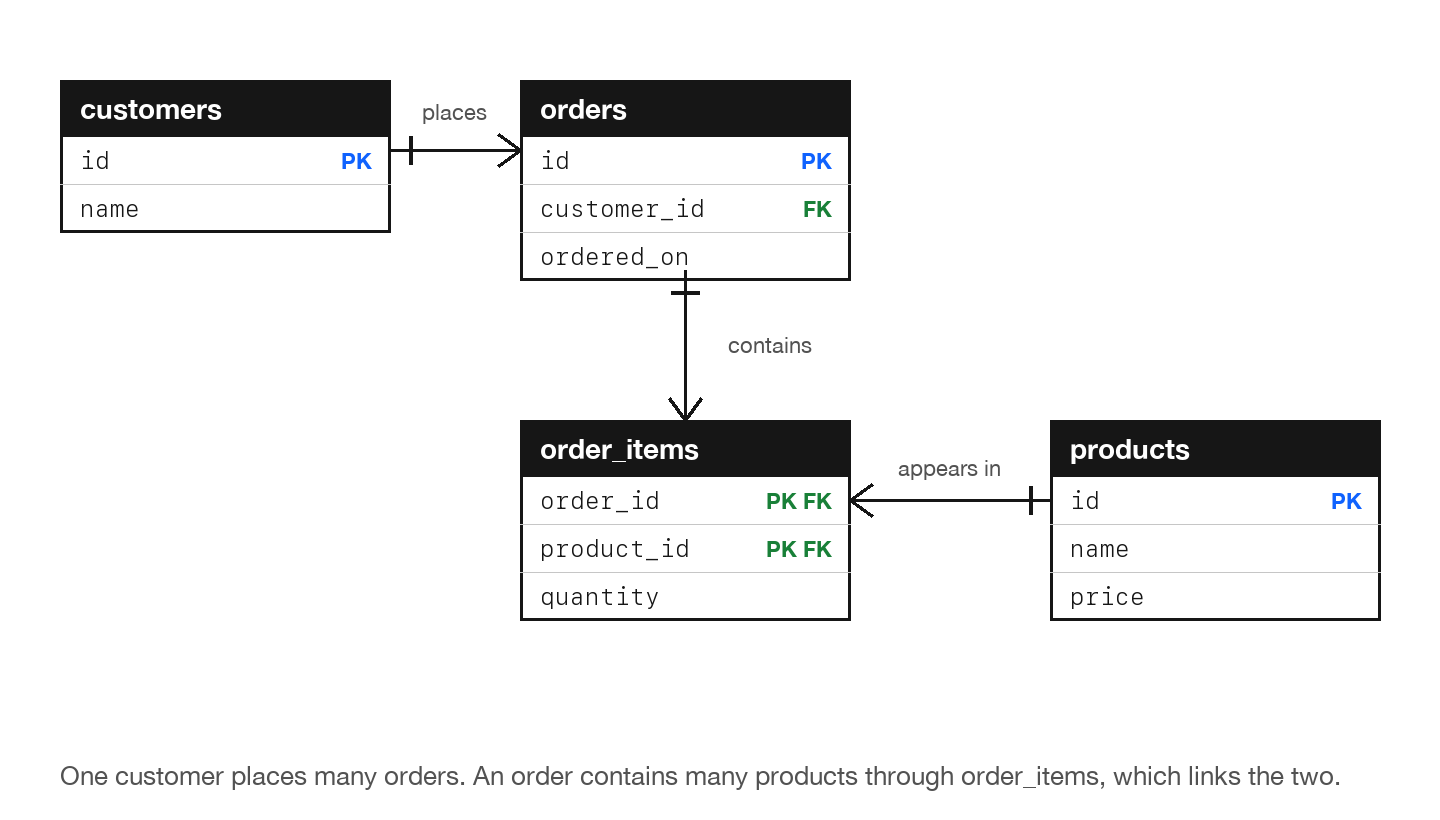
| Mark | What to look for |
|---|---|
| Table box | The entity or record type, then the columns it contains. |
| PK | The primary key. It may consist of more than one column. |
| FK | A foreign key referencing a key in another table, or sometimes the same table. |
| Crow's foot | The many side of a relationship in this notation. Read it together with the minimum-cardinality symbol. |
| Circle or bar | Usually optional or required participation in crow's-foot notation. Check the tool's legend; notation varies. |
Follow one order
Start at orders, because that is the record your question counts. A customer can have multiple orders. Each order can have multiple lines. Each line points to a product. Moving toward the many side can increase the row count; moving back toward a unique parent usually does not.
A junction table connects two sets of records. In this illustration, order_items connects orders and products. Some real schemas allow the same product on several lines and use a line number or a separate line ID. Read the actual key before assuming that an order/product pair is unique.
A drawn line is not the whole rule
A foreign key can reference an eligible unique key, not only a primary key. A nullable foreign key can allow no parent value. A unique constraint on the foreign key can also change the relationship from many-to-one to one-to-one. Inspect the constraints as well as the picture.
Diagrams generated from declared foreign keys may omit relationships the application enforces itself. Some tools let you add inferred or manual links. A missing line is a reason to investigate, not proof that two tables are unrelated.
Check the relationship in SQLite
PRAGMA foreign_key_list(orders);
PRAGMA table_info(orders);
PRAGMA foreign_keys;
The last command reports whether foreign key enforcement is enabled on this connection. Set PRAGMA foreign_keys = ON; before starting a transaction when you need enforcement. Do not assume every application enables it. To inspect existing violations, use PRAGMA foreign_key_check;.
Schema diagram questions
- What is the difference between a schema diagram and an ER diagram?
- Usage overlaps. An ER diagram can model conceptual entities, while a physical schema diagram shows implemented tables and constraints. Check which level the diagram represents.
- Does a foreign key always point to a primary key?
- No. Databases such as PostgreSQL and SQLite also allow references to suitable unique keys, subject to their rules.
- Why does a join duplicate rows?
- One row can match several rows on the other side. Check the intended grain of the result and the uniqueness of the join keys before adding DISTINCT.